Softer Inflation Lifts Stocks to Fresh Highs
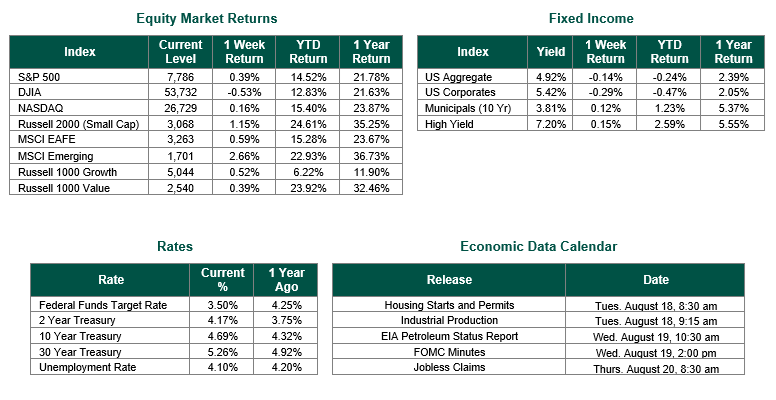
Global equity markets finished mixed for the week. In the U.S., the S&P 500 Index closed the week at a level of 7786, representing an increase of 0.39%, while the Russell Midcap Index moved +1.50% last week. Meanwhile, the Russell 2000 Index, a measure of the Nation’s smallest publicly traded firms, returned +1.15% over the week. As developed international equity performance and emerging markets were positive, returning +0.59% and +2.66%, respectively. Finally, the 10-year U.S. Treasury yield moved higher, closing the week at 4.69%.
Last week was defined by a decisive shift in the market’s inflation and interest rate narrative, as cooler-than-expected July inflation data reinforced expectations that the Federal Reserve will remain patient and paved the way for another round of new all-time highs on the S&P 500. The tone was set on Wednesday morning with the July Consumer Price Index release, which showed headline prices rising just 0.1% month-over-month and 3.4% year-over-year, while core CPI matched expectations at 0.2% month-over-month and 2.5% year-over-year. The relief rally continued Thursday after wholesale prices came in even lighter than expected, effectively closing the door on the rate hike concerns that had gripped markets just three weeks earlier.
The combination of last week’s inflation prints, and the prior Friday’s soft July jobs report has fundamentally reshaped the outlook for monetary policy. As a reminder from that print, the economy shed 23,000 jobs in July against expectations for a gain of 80,000, wage growth softened to just 0.1% month-over-month, and prior months were revised meaningfully lower. Yet the unemployment rate ticked down to 4.1%, its lowest level in five years, largely reflecting continued declines in labor force participation. Historically, when payroll growth over a three-month period averages fewer than 20,000 jobs, as it has recently, the Fed has raised rates in only about 9% of subsequent six-month windows and cut rates roughly 70% of the time, according to Baird Strategas. Futures markets have reflected that shift decisively, with the probability of a September rate hike collapsing and pricing now leaning toward holding steady or even a cut before year-end. The 2-year Treasury yield has led the move lower, though the long end of the curve has been more stubborn, with the 10-year yield closing the week at 4.65% as investors continue to weigh higher oil prices, elevated fiscal deficits, and lingering inflation expectations.
Even as the broader tape moved higher, cracks in the consumer story emerged late in the week and served as a useful reminder that the Fed’s dilemma is not purely about inflation. Friday’s July retail sales report came in weaker than expected, and consumer sentiment continued to deteriorate, with households citing pressure from cumulative price increases and general economic uncertainty. Existing home sales fell an additional 1.7% in July to 4.06 million, extending the housing market’s malaise as elevated mortgage rates continue to freeze both supply and demand. The Middle East backdrop also remained a live risk, with Iran’s newly appointed naval chief publicly declaring the Strait of Hormuz to be under Iranian control and management, keeping oil prices pinned near $82 per barrel and providing continued support for the safe-haven bid in gold, which has quietly been one of the year’s best-performing assets.
Looking to the week ahead, the calendar is lighter on hard data but heavier on Fed communication and consumer earnings. The minutes from the July 28-29 FOMC meeting will be released Wednesday afternoon and will be scrutinized for signs of how divided the committee was, particularly given that three officials were reportedly leaning toward a hike at the time. Tuesday brings July housing starts and building permits, and a wave of major retail earnings, including several of the country’s largest home improvement and general merchandise retailers, will provide the most important read yet on the health of the American consumer heading into the back-to-school and holiday seasons. Preliminary S&P Global PMIs on Friday round out the data calendar. Above all of it, the Jackson Hole Economic Symposium later this month looms as the marquee event of the summer, with Chairman Warsh’s first keynote as Fed Chair likely to set the tone for policy expectations through the fall.
Best wishes to all for the week ahead!
Equity and Fixed Income Index returns sourced from Bloomberg on 8/14/26. CPI and PPI sourced from the Bureau of Labor Statistics. Retail sales sourced from the Census Bureau. Existing home sales sourced from the National association of Realtors. International developed markets are measured by the MSCI EAFE Index, emerging markets are measured by the MSCI EM Index, and U.S. Large Caps are defined by the S&P 500 Index. Sector performance is measured using the GICS methodology.
Disclosures: Past performance does not guarantee future results. We have taken this information from sources that we believe to be reliable and accurate. Hennion and Walsh cannot guarantee the accuracy of said information and cannot be held liable. You cannot invest directly in an index. Diversification can help mitigate the risk and volatility in your portfolio but does not ensure a profit or guarantee against a loss.