Surge in Corporate Earnings Meets Labor Weakness
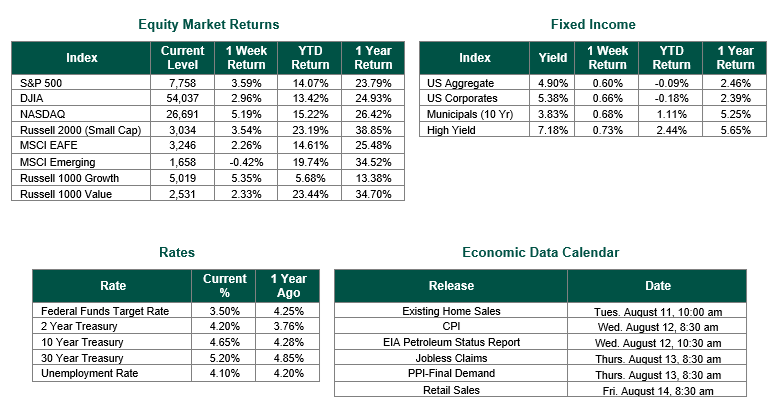
Global equity markets finished mixed for the week. In the U.S., the S&P 500 Index closed the week at a level of 7758, representing an increase of 3.59%, while the Russell Midcap Index moved +3.19% last week. Meanwhile, the Russell 2000 Index, a measure of the Nation’s smallest publicly traded firms, returned +3.54% over the week. As developed international equity performance and emerging markets were mixed, returning +2.26% and -0.42%, respectively. Finally, the 10-year U.S. Treasury yield moved lower, closing the week at 4.65%.
Last week, U.S. economic news was dominated by a very strong S&P 500 second-quarter earnings season and a soft labor report. FactSet’s August 7 update showed that the S&P 500’s blended Q2 earnings growth rate had risen to 50.4%, up from 47.4% the prior week and 23.1% at the end of the quarter, reflecting broad upside surprises as more companies reported results.
FactSet also indicated that the index’s earnings outlook improved materially during the reporting cycle, with all eleven sectors showing higher earnings than at the start of the quarter. By that stage of reporting, 88% of S&P 500 companies had reported actual results, and 86% had posted positive EPS surprises while 76% had delivered positive revenue surprises. The earnings beat rate remained far above the five-year average, underscoring that corporate profitability was running well ahead of expectations across a wide range of industries.
The quarter’s performance was especially notable because the earnings growth rate was not just positive, but the strongest since Q2 2021 if the final figure holds. FactSet’s update also pointed to unusually strong company-level contributions from some of the largest index members, helping lift the overall earnings trajectory and reinforcing the idea that mega-cap results continued to matter disproportionately for the index.
On the labor side, the employment environment weakened sharply relative to both prior periods and consensus forecasts. The U.S. economy lost 23,000 nonfarm payroll jobs in July, reversing the revised gain of 20,000 in June and missing expectations by a wide margin; surveyed economists had expected about 83,000 new jobs, while another consensus estimate was 95,000.
The unemployment rate edged down to 4.1% from 4.2%, but that improvement came against the backdrop of downward revisions to prior months, including a combined 103,000-job reduction for May and June.
Taken together, the week ending August 7 showed a clear divergence between corporate America and the labor market. Earnings season was delivering exceptionally strong second-quarter profit growth and a very high share of beats versus consensus, while employment data pointed to a softer and more fragile demand backdrop than economists had anticipated.
Best wishes to all for the week ahead!
Equity and Fixed Income Index returns sourced from Bloomberg on 8/7/26. Second quarter corporate earnings results and statistics are sourced from FactSet. Employment Situation Report is sourced from the U.S. Bureau of Labor Statistics. International developed markets are measured by the MSCI EAFE Index, emerging markets are measured by the MSCI EM Index, and U.S. Large Caps are defined by the S&P 500 Index. Sector performance is measured using the GICS methodology.
Disclosures: Past performance does not guarantee future results. We have taken this information from sources that we believe to be reliable and accurate. Hennion and Walsh cannot guarantee the accuracy of said information and cannot be held liable. You cannot invest directly in an index. Diversification can help mitigate the risk and volatility in your portfolio but does not ensure a profit or guarantee against a loss.