Hawkish Jackson Hole Speech Amidst Lingering Inflation
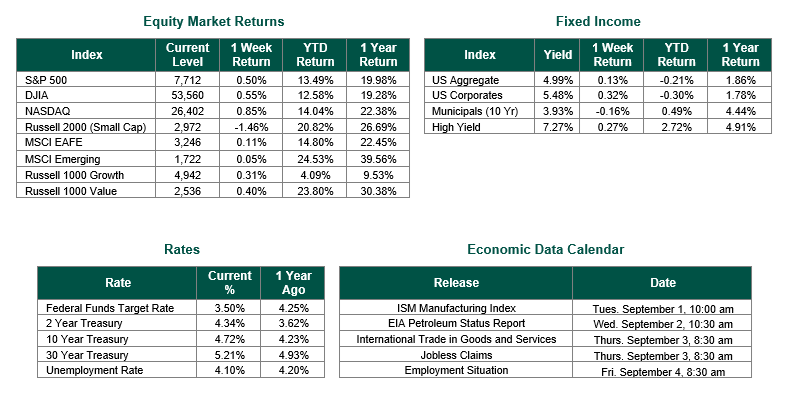
Global equity markets finished mixed for the week. In the U.S., the S&P 500 Index closed the week at a level of 7712, representing an increase of 0.50%, while the Russell Midcap Index moved -1.03% last week. Meanwhile, the Russell 2000 Index, a measure of the Nation’s smallest publicly traded firms, returned -1.46% over the week. As developed international equity performance and emerging markets were positive, returning +0.11% and +0.05%, respectively. Finally, the 10-year U.S. Treasury yield moved lower, closing the week at 4.72%.
Last week’s economic landscape was defined by a string of significant data releases, alongside Federal Reserve Chairman Kevin Warsh’s first keynote speech at the Jackson Hole Economic Policy Symposium. Markets experienced heightened volatility as Chairman Warsh signaled that curbing inflation remains the central bank’s absolute priority, shifting investor expectations toward a potential upcoming interest rate hike.
Federal Chair Kevin Warsh took center stage on Friday, August 28th, delivering a hawkish keynote address at the annual Jackson Hole Economic Policy Symposium. Warsh hammered home a strict message emphasizing that taming inflation and returning it to the Fed’s fixed 2% target remains the paramount objective. Expressing explicit concern over July’s stubborn 3.7% headline inflation reading, Warsh warned that recent brief relief did not signal a meaningful trend improvement, and he noted that financial conditions are not yet restrictive. By declaring that the Fed still “has work to do” if inflation does not start to subside quickly, he opened the door to immediate rate hikes. Financial markets reacted swiftly; traders raised the implied probability of a September rate hike from 36% to 56% via the CME Group FedWatch Tool. Bond yields flattened while equity markets retraced, with the S&P 500 pulling back slightly on Friday to close at 769.35, down from Thursday’s peak of 771.10.
Earlier in the week, on Wednesday, August 26th, the U.S. Bureau of Economic Analysis released its second estimate for second-quarter Gross Domestic Product (GDP). The headline real GDP growth rate held steady at an annualized pace of 1.5%, perfectly matching the advance estimate and aligning with analyst expectations of a mild cooling trend from the first quarter’s 2.1% expansion. Despite the unchanged top-line number, the report’s internal details showed robust private domestic demand, consumer spending, and business investment. However, these positive drivers were almost entirely offset by a drop in government spending and a sharp increase in imports. Analysts viewed the stable reading as verification that the broader corporate sector remains fundamentally insulated from a near-term recessionary breakdown.
Simultaneously, the July Personal Income and Outlays report underscored persistent inflationary friction. Personal income rose by 0.4% ($115.1 billion), primarily driven by private wages and asset dividends, outpacing near-term inflation. Meanwhile, personal consumption expenditures increased by 0.2%, slowing from June but exceeding the modest 0.1% gain anticipated by analysts. The monthly headline Personal Consumption Expenditures (PCE) price index rose 0.2%, coming in hotter than the consensus estimate of 0.1%. This reading kept the annual headline PCE inflation rate sticky at 3.7%, slightly defying Wall Street expectations of a forecasted moderation to 3.6%. Conversely, the annual core PCE metric, which strips out the more volatile food and energy costs, landed exactly in line with expectations at 3.3%, confirming that structural price pressures remain firmly dug in for the time being.
On Thursday, August 27th, the labor market provided further evidence of structural strength with the weekly initial jobless claims report. For the week ending August 22nd, initial applications for state unemployment benefits fell by 4,000 to a seasonally adjusted total of 203,000, outperforming market expectations polled by Reuters, which predicted an increase to 208,000. This result kept claims positioned at the historical lower end of their annual range, indicating that corporate layoffs remain remarkably rare, consistent with the persistent “No Hire, Nor Fire” state of the jobs market. Continuing claims also beat expectations, slipping by 18,000 to a seasonally adjusted 1.778 million. Several economists believe that this level of labor resilience provides the Federal Reserve with an ample economic cushion to sustain tighter monetary policy without inducing immediate workforce distress.
Despite labor market strength, household sentiment metrics took a visible hit due to inflation and geopolitical tensions. The Conference Board Consumer Confidence Index dipped to 89.4 from a revised 90.2 in July, hitting a seven-month low. While consumers’ view of the present situation improved slightly, the forward-looking Expectations Index plunged 5.8 points to 68.2, falling further below the critical threshold historically linked to recession risks. Compounding this, the final August Consumer Sentiment report from the University of Michigan, released last Friday, showed a monthly contraction to 51.7. Although slightly above the preliminary reading of 51.0, it sat 11.2% lower on a year-over-year basis. Surveyed consumers explicitly cited persistently high gasoline prices above $4 per gallon and ongoing uncertainty surrounding the conflict with Iran as the main anchors dragging down their long-term economic outlook.
Best wishes to all for the week ahead!
Equity and Fixed Income Index returns sourced from Bloomberg on 8/28/26. Future interest rate probabilities are sourced from CME Group FedWatch. GDP data is sourced from the U.S. Bureau of Economic Analysis. Personal Income and Outlays are sourced from the U.S. Department of Commerce. Weekly Jobless Claims are sourced from the U.S. Department of Labor. Consumer Confidence index is sourced from The Conference Board. International developed markets are measured by the MSCI EAFE Index, emerging markets are measured by the MSCI EM Index, and U.S. Large Caps are defined by the S&P 500 Index. Sector performance is measured using the GICS methodology.
Disclosures: Past performance does not guarantee future results. We have taken this information from sources that we believe to be reliable and accurate. Hennion and Walsh cannot guarantee the accuracy of said information and cannot be held liable. You cannot invest directly in an index. Diversification can help mitigate the risk and volatility in your portfolio but does not ensure a profit or guarantee against a loss.