The Fed Hikes for the First Time Since 2023
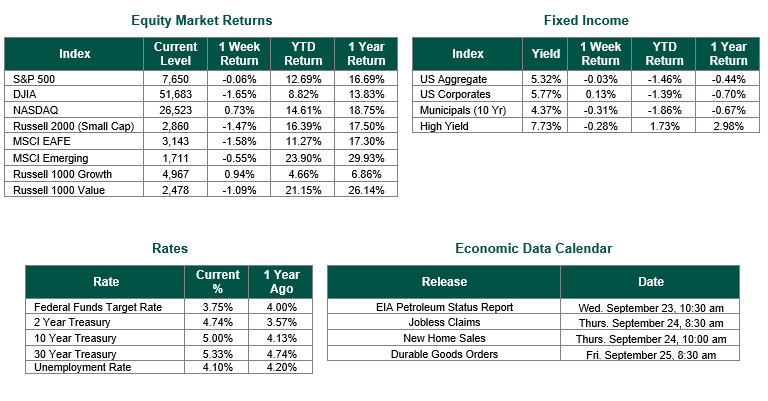
Global equity markets finished mixed for the week. In the U.S., the S&P 500 Index closed the week at a level of 7650, representing a decrease of 0.06%, while the Russell Midcap Index moved 1.17% lower last week. Meanwhile, the Russell 2000 Index, a measure of the Nation’s smallest publicly traded firms, returned -1.47% over the week. As developed international equity performance and emerging markets were negative, returning -1.58% and -0.55%, respectively. Finally, the 10-year U.S. Treasury yield moved higher, closing the week at 5.00%.
The Federal Reserve raised its target range for the federal funds rate by 25 basis points on Wednesday afternoon, to 3.75%-4.00%. This move represented the first rate hike by the Fed since 2023, and it came at the third meeting chaired by Kevin Warsh. The decision itself was not in question, with better than a 90% probability of a hike priced-in going into the announcement; the vote was. The final tally was 12 to 0, from the same Committee that produced three dissents in July. The statement was also shorter and plainer than what the Fed has been publishing. Inflation “remains elevated,” it read, and “Today’s policy action will support a timelier return to the Committee’s 2% goal.” It closed with this: “The Committee will deliver price stability.”
What seemingly disappointed market participants was not the hike. It was the projections. The Fed now forecasts approximately one more 25-basis-point increase before year-end, and it has only two meetings left in which to deliver it, one at the end of October and the last of the year, concluding on December 9. The dot plot was not unanimous on the point. Of the 16 participants who supplied a dot, 10 favored one additional hike, four favored two more, and two favored none at all. Chair Warsh supplies no dot and provides no forward-looking forecasts in the Summary of Economic Projections, so the published path does not include its Chair. Past this year, the median path flattens, with no change projected for 2027, one cut in 2028, and at least one more in 2029.
The updated economic projections gave the Committee its cover. Real GDP for 2026 was raised to 2.3% from 2.2% in June, the unemployment rate was lowered to 4.1% from 4.2%, and core PCE inflation was raised to 3.4% from 3.3%. The Fed still has core PCE falling to 2.5% next year, though it does not get inflation back to the 2% target until 2029. Between those forecasts, the continued strength of corporate earnings and an economy that keeps proving resilient, the Fed had enough room to address the price stability half of its dual mandate and keep its credibility with a market that had already decided a hike was coming.
In our view, 25 basis points on its own does very little. It will not slow the economy, and it will do little to address inflationary pressure fueled by energy prices. If this is the start of a rate hike cycle rather than a single adjustment, that changes everything, and that is most likely what the tape was reacting to.
Equity markets seemingly could not agree on what to make of the Federal Reserve’s decision. The Dow lost 1.65% on the week, a third consecutive decline and its worst since March, while the Nasdaq Composite gained 0.73% and the S&P 500 finished almost exactly where it began. The Russell 1000 Growth Index rose 0.94%, and the Russell 1000 Value Index fell 1.09%. Small caps, which tend to carry more floating-rate debt, fell 1.47%. The bond market was less ambiguous. The 10-year U.S. Treasury yield traded above 5% during the week, its highest level since July 2007, and closed at 5.00%, while the 2-year U.S. Treasury rose about 12 basis points to 4.74% and the 30-year slipped to 5.33%.
The data released around the meeting leaned the same way. August retail sales, published last Wednesday morning, rose 1.2% to $773.9 billion and were 6% higher than a year ago, more than reversing July’s decline. Initial jobless claims for the week ended September 12 fell to 196,000 against a consensus of 207,000, though claims around Labor Day are always a little suspect. Housing was the exception, with total starts down 2.6% in August and permits down 2.7%. Crude oil prices stayed in the way of any relief on inflation, with WTI Crude Oil settling Friday at $100.30.
This upcoming week is quiet by comparison, with the EIA petroleum status report due on Wednesday, jobless claims and new home sales on Thursday, and durable goods orders on Friday. That leaves five weeks and two more inflation reports before the Fed’s next meeting in October. We would not be surprised to see the projected path of rate cuts pulled forward if and when a more sustainable ceasefire is reached between the United States and Iran, the Strait of Hormuz returns to more normal operations, oil and gas prices recede, and inflationary pressures moderate back toward the Fed’s 2% target. Until then, the only opinions that matter on this front are those of Chair Warsh and the voting members of the FOMC, and trying to play the Fed-guessing game remains as counterproductive as ever.
Best wishes to all for the week ahead!
Equity and Fixed Income Index returns sourced from Bloomberg on 9/18/26. The FOMC statement, the dot plot, and the Summary of Economic Projections are sourced from the Federal Reserve. Rate hike probabilities are sourced from CME Group FedWatch. August retail sales and new residential construction data are sourced from the U.S. Census Bureau. Weekly jobless claims are sourced from the U.S. Department of Labor. Crude oil prices are sourced from Bloomberg. International developed markets are measured by the MSCI EAFE Index, emerging markets are measured by the MSCI EM Index, and U.S. Large Caps are defined by the S&P 500 Index. Sector performance is measured using the GICS methodology.
Disclosures: Past performance does not guarantee future results. We have taken this information from sources that we believe to be reliable and accurate. Hennion and Walsh cannot guarantee the accuracy of said information and cannot be held liable. You cannot invest directly in an index. Diversification can help mitigate the risk and volatility in your portfolio, but does not ensure a profit or guarantee against a loss.