Strong Corporate Earnings Overshadowed by the Resignation of Nvidia’s CEO
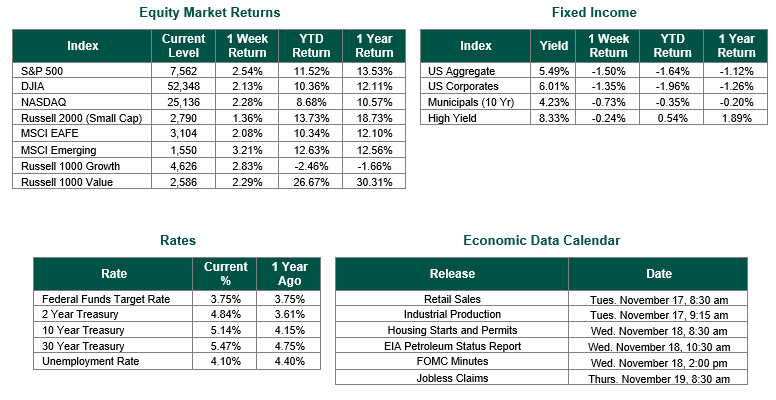
Global equity markets finished higher for the week. In the U.S., the S&P 500 Index closed the week at a level of 7562, representing an increase of 2.54%, while the Russell Midcap Index moved +2.51% last week. Meanwhile, the Russell 2000 Index, a measure of the Nation’s smallest publicly traded firms, returned +1.36% over the week. As developed international equity performance and emerging markets were positive, returning +2.08% and +3.21%, respectively. Finally, the 10-year U.S. Treasury yield moved higher, closing the week at 5.14%.
While the news cycle for the prior week was dominated by the sudden change of leadership at Nvidia Corporation (NVDA: NASDAQ), there were other important developments that affected markets throughout the past week. Throughout this Update, we intend to review and analyze all of the developments.
On Tuesday, the October 2026 Consumer Price Index (CPI) were released by the U.S. Bureau of Labor Statistics, showed that headline inflation rose 0.4% month-over-month on a seasonally adjusted basis, exceeding consensus estimates of 0.3%. Core CPI, which excludes volatile food and energy costs, increased 0.3% month-over-month, also topping economists’ projections of 0.2%. Compared to the prior month, the headline pace moderated from September’s 0.6% surge, while the core monthly gain held steady at September’s 0.3% rate.
On Thursday, NVIDIA announced the immediate resignation of Jensen Huang as president, CEO, and board member following revelations regarding personal relationships and an independent board probe. The board appointed longtime Chief Financial Officer Colette Kress as interim CEO while naming veteran director Harvey Jones as the company’s first-ever Chair of the Board. Across the broader AI ecosystem, Huang’s sudden exit has introduced major succession and execution uncertainty, raising questions about whether NVIDIA can maintain its aggressive annual product cadence and tight coordination with foundries, hyperscalers, and industrial partners. The transition has also placed heavy scrutiny on NVIDIA’s “circular financing” model—its massive capital investments in major customers and cloud partners. Investors and policymakers weigh whether interim leadership will maintain those commitments or impose stricter financial discipline. While underlying demand for AI compute remains strong and near-term chip supply is locked in, the shakeup has heightened market volatility, sparked intense debate over a potential external replacement or a lobbying push for Huang’s return, and rattled investor confidence ahead of the company’s upcoming earnings report.
Third quarter earnings season is nearing its conclusion with very powerful results recorded thus far. As of November 13, FactSet has reported that 91% of S&P 500 companies have reported, showing 31.9% blended year-over-year earnings growth. If that pace holds, it will mark the third consecutive quarter of earnings growth above 25% for the index. 84% of reporting companies beat EPS estimates (above the 78% five-year average), and 74% beat revenue estimates with a blended year-over-year revenue growth rate of 14.4%. However, the aggregate earnings surprise magnitude is 3.1% above estimates, which is below historical averages and the lowest since Q4 2022. Ten of eleven sectors experienced upward earnings revisions since September 30, raising overall growth projections from 29.1% to 31.9%. Conversely, Communication Services is the sole sector with a negative aggregate surprise (-22.1%), dragging its blended growth down to 18.2%. The S&P 500’s forward 12-month P/E ratio stands at 18.3, coming in below its 5-year (19.8) and 10-year (19.1) averages.
In addition to NVIDIA’s earnings, market participants will get meaningful information concerning the status of the U.S. consumer as important retailers will report earnings. The major retailers include Walmart Inc. (WMT: NASDAQ), Home Depot, Inc. (HD: NYSE), Target Corp (TGT: NYSE) and TJX Companies, Inc. (TJX: NYSE). Markets are focused on the upcoming IPO of Anthropic. The offering targets a price range of $70 to $78 per share, which would value the company at up to $1.405 trillion on a fully diluted basis and potentially make it the largest initial public offering in history.
Best wishes to all for the week ahead!
Equity and Fixed Income Index returns sourced from Bloomberg on 11/13/26. Corporate earnings data are sourced from FactSet. Consumer Price Index (CPI) are sourced from the U.S. Bureau of Labor Statistics. International developed markets are measured by the MSCI EAFE Index, emerging markets are measured by the MSCI EM Index, and U.S. Large Caps are defined by the S&P 500 Index. Sector performance is measured using the GICS methodology.
Disclosures: Past performance does not guarantee future results. We have taken this information from sources that we believe to be reliable and accurate. Hennion and Walsh cannot guarantee the accuracy of said information and cannot be held liable. You cannot invest directly in an index. Diversification can help mitigate the risk and volatility in your portfolio, but does not ensure a profit or guarantee against a loss.